 EN
EN
In the fast-paced hospitality, commercial laundry, and self-service laundry sectors, laundry efficiency directly impacts business turnover and customer satisfaction. As a leader in smart laundry ecosystems, Flying Fish engineers commercial equipment that balances speed, performance, and energy efficiency. A key question for businesses investing in such solutions is: How long does it typically take to wash and dry clothes in commercial equipment? The answer hinges on equipment type, load capacity, and technological design—areas where Flying Fish’s innovations optimize every step.
Key Factors Shaping Wash and Dry Times
Unlike residential machines, commercial equipment prioritizes high-volume processing without sacrificing consistency. For Flying Fish’s washers and dryers, three core factors define cycle duration. Load capacity influences speed: larger models handle bulk loads but are calibrated for efficiency, while compact units maintain quick cycles for smaller volumes. Technological design, such as front-door air inlets in dryers and self-calibrating washers, streamlines processes by enhancing heat distribution and reducing manual adjustments. Cycle customization also plays a role—different commercial settings demand tailored programs, from fast “daily use” cycles for hotels to thorough options for heavy-duty fabrics.
Typical Wash Times for Flying Fish Commercial Washers
Flying Fish’s commercial washers range from compact Vended Washer Extractors to heavy-duty Industrial Washer Extractors, all aligned with the brand’s “double efficiency, half the energy” focus. Small to mid-capacity washers, ideal for self-service laundries and small commercial use, complete standard cycles in 45–55 minutes. Models like the 15KG Soft-mount Washer Extractor use precision water level control and chemical dosing to cut time, with a “quick wash” option for lightly soiled linens reducing cycles to 35–40 minutes. Large-capacity industrial washers, built for high-volume settings, handle bulk loads in 50–65 minutes. Their multi-layer protection and high-speed precision eliminate rewashes, while self-calibrating accuracy ensures consistent cleaning without delays. These washers also reduce labor costs via automated detergent dosing, letting operators monitor multiple machines simultaneously.
Typical Dry Times for Flying Fish Commercial Dryers
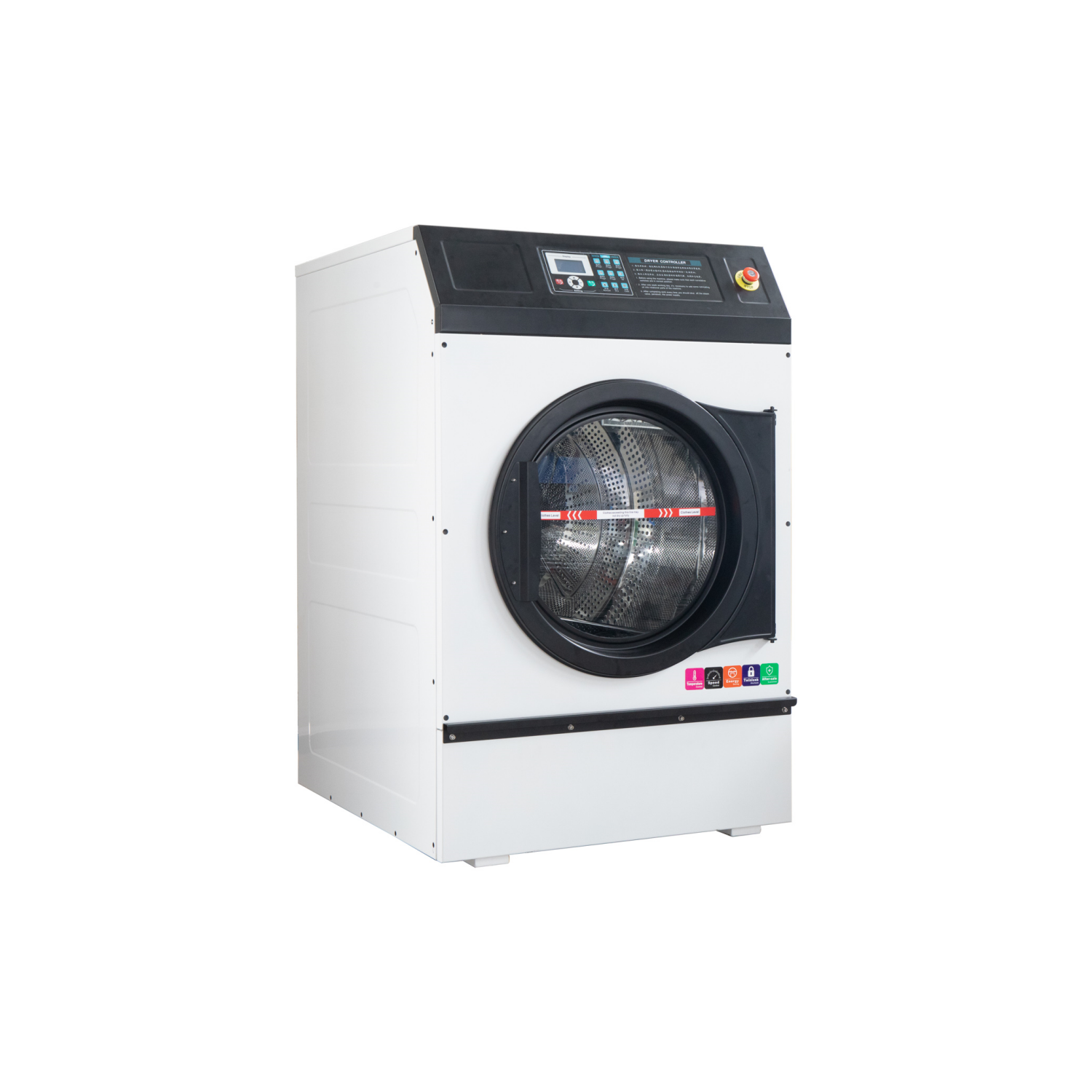
Drying is often a common bottleneck in the linen processing workflow, yet Flying Fish’s Energy-saving Tumble Dryers resolve this issue effortlessly with innovative heat management technology. Equipped with four core features, the dryers achieve a comprehensive boost in drying efficiency: front-door air intake design, top-mounted enclosed heat recovery system, multi-filter setup for unobstructed air flow, and proprietary customized hot air circulation technology.
The small and medium-capacity dryers, designed for scenarios such as self-service laundries and small hotels, have a standard drying cycle of 40 minutes, while also allowing users to independently and flexibly adjust the drying duration according to fabric type, soiling level and dryness requirements. Their hot air circulation design greatly improves heat utilization efficiency, cutting drying time by 30% compared with conventional models. For lightweight fabrics, users can also directly activate the preset "Quick Dry" mode, which further reduces the drying time to 25–30 minutes.
The large-capacity dryers, engineered for industrial-scale processing needs, have a standard cycle of 40 minutes for bulk linen drying and are equipped with a custom duration adjustment function, which can precisely meet the differentiated drying requirements of various linen types such as hotel bed sheets, bath towels and catering tablecloths. The top-mounted enclosed heat recovery system minimizes energy waste, and the easy-to-clean front-door lint filters prevent air flow blockages from the source. At the same time, this series of dryers reduces steam consumption by 50%, striking a perfect balance between faster drying speed and the sustainable development needs of energy conservation and environmental protection.
Real-World Example: Hotel Linen Processing
A mid-sized 200-room hotel processing 320KG of linens daily illustrates practical efficiency. Using Flying Fish’s 50KG Industrial Washer Extractor and 50KG Energy-saving Tumble Dryer, the wash stage takes 50 minutes per cycle—7 cycles totaling 350 minutes. The dry stage runs 40 minutes per cycle (with flexible adjustment available according to fabric needs), with 7 cycles taking 280 minutes. With overlapping cycles, all daily linen processing completes in under 8 hours, cutting 20–30% of time compared to traditional equipment and supporting faster room turnover.
Tips to Optimize Wash and Dry Times
Businesses can further maximize efficiency with simple steps. Load machines properly—avoid overloading or underloading, following clear capacity markers. Clean lint filters after every cycle; Flying Fish’s front-bottom filters take 2 minutes to maintain and prevent 10–15 minute delays. Use recommended detergents for effective disinfection, ensuring thorough cleaning in one cycle. Choose the right cycle based on soil level, leveraging intuitive controls to select optimal programs quickly.
Why Flying Fish Stands Out
Flying Fish’s commercial equipment delivers speed without compromising durability or sustainability. Backed by 20 years of production experience and availability in 120+ countries, the brand’s washers and dryers handle continuous high-volume use while cutting energy and labor costs by 50%. Whether for hotels, self-service laundries, or large commercial facilities, Flying Fish ensures predictable, efficient, and cost-effective wash and dry times—turning speed into measurable business value.