
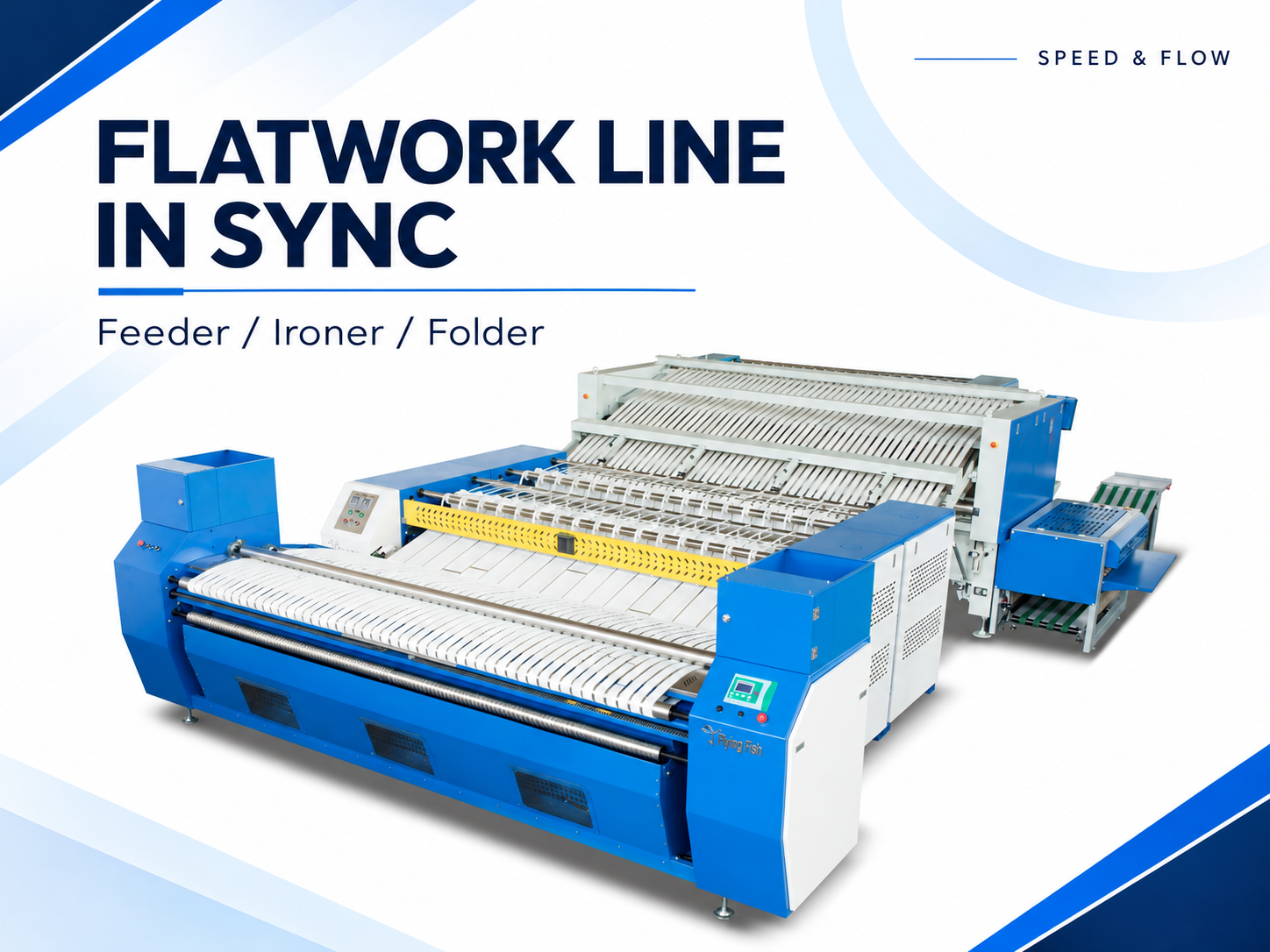
A fast ironer does not guarantee a productive flatwork line. If sheets arrive unevenly, leave the ironer damp, or bunch up at the folder entrance, increasing the speed may only create more rework.
Start by checking three things:
● Feeding consistency:Are operators able to supply linen straight and at an even pace?
● Moisture removal:Can the ironer evaporate sufficient moisture at the selected speed without leaving damp hems?
● Transfer stability:Does each piece transfer smoothly from ironer to folder without skewing or bunching?
These checks help identify what is limiting output before operators change machine drive settings. This guide explains how feeding, ironing, folding, and stacking affect one another—and which operating conditions to evaluate when balancing the finishing line.
On a manual infeed setup, two operators lift, shake out heavy creases, locate corners, and feed the leading edge directly into the ironer. Under continuous operation with large bed sheets (such as sheets measuring 2.8 m across), manual feeding pace varies based on linen weight, extraction condition, and operator fatigue.
For example, an operator pair feeding a sheet every 20 seconds achieves an infeed rate of roughly 180 sheets per hour, while an infeed cycle of 35 seconds yields around 100 sheets per hour. If the ironer is set to run faster than operators can physically feed sheets squarely, the ironer simply runs with empty gaps between sheets, consuming steam without increasing output.
A single-station suction feeder helps stabilize this transfer in several practical ways:
● Perforated Suction Belt: A perforated conveyor belt connected to an internal exhaust chamber draws air through the belt, helping hold the linen flat against the conveyor surface during feeding.
● Trailing-Edge Smoothing: Air suction in the lower chamber helps pull and smooth the trailing edge as it enters the machine, reducing folded corners.
●Transfer Speed Coordination: The transfer speed between the feeder and the ironer infeed must be adjusted according to machine design and linen type. Setting upstream and downstream belts incorrectly can either stretch fabric or create excess slack that leads to bunching. Speeds should follow manufacturer commissioning recommendations.
● Lint Maintenance: Suction fans naturally collect loose lint over time. Inspection windows and doors should be checked regularly so airflow remains unrestricted throughout working shifts.
In roller ironers (such as models equipped with 800 mm diameter stainless steel cylinders), drying capacity depends on the total heated surface area, steam supply condition, and initial moisture content of the washed linen.
● Surface Condition: Precision-finished stainless steel cylinders allow damp linen to glide under tensioned Nomex guiding ribbons with minimal friction while resisting corrosion from washroom chemicals.
● Moisture Evaporation: Incoming residual moisture varies with fabric composition, load conditions, and the extraction program. Measure it for the linen being processed rather than assuming a fixed value:
Residual Moisture Content (dry basis) = (Wet Weight − Dry Weight) ÷ Dry Weight × 100%
To reach an acceptable moisture target for folding, the linen must spend sufficient contact time across the heated cylinders. Adding roller stages (single-roller, double-roller, or three-roller configurations) increases effective contact length, allowing higher linear speeds for the same drying standard.
Line capacity is governed by linear speed, piece length along the direction of travel, and the gap between consecutive pieces:
Theoretical Throughput (pieces per hour) = 60 × Line Speed (m/min) ÷ [Linen Length in Travel Direction (m) + Piece Gap (m)]
For example, running at a line speed of 18 m/min with a 2.8 m sheet length and a 0.3 m feeding gap (3.1 m total pitch length) yields a theoretical single-lane throughput of:
(60 × 18) ÷ 3.1 ≈ 348 pieces per hour
This illustrates how an operating target around 350 sheets per hour can be calculated under specific speed and spacing assumptions. In practice, achieving this depends on maintaining adequate cylinder temperature, consistent infeed pacing, and reliable folder cycling without faults.
Maintain the specified steam inlet pressure under operating load and verify that condensate drains correctly. Rotary joints inject live steam through the cylinder journal and evacuate condensate. Restricted condensate drainage can cause condensate to accumulate inside the cylinder, reducing effective heat transfer and causing incomplete or uneven drying.
The control system uses leading- and trailing-edge detection together with conveyor travel information to determine piece length and trigger the selected folding sequence. On units such as the ZD-3300, blade folding is utilized across folding stages following initial pre-folding.
Folders may advertise high mechanical speed capabilities (such as up to 50 or 60 m/min). Actual capacity also depends on the folding program, piece spacing, and stacker cycle:
● Fold Cycle Time: Executing lateral folds and subsequent cross folds requires precise mechanical actuation intervals.
● Piece Spacing: If the arrival interval is shorter than the folder or stacker can handle for the selected program, the line may require greater spacing or a lower feed rate.
● Stacker Clearing: Stacking units must index and clear finished bundles to the discharge table without halting incoming pieces.
The intake conveyor of the folder is often set slightly faster than the ironer discharge to ensure a clean, taut transfer and prevent leading-edge curling. However, excessive speed differences can generate static electricity or cause transfer misalignment. Speed settings should be matched according to the transfer arrangement and control interface between ironer and folder.
A common question in flatwork plant layout is how to process small items (such as pillowcases, napkins, and kitchen towels) alongside large bed sheets.
Wide 3.0 m to 3.3 m flatwork ironers can process small pieces effectively when equipped with multi-lane feeding (typically 2 to 4 lanes). Operators feed several small pieces side-by-side across the cylinder width.
● Advantage: Avoids the capital investment and floor space of a separate machine when small-piece volume is moderate.
● Limitation: If operators only feed a single small piece down the center of a wide roller, the unused outer cylinder surface radiates heat into the room without doing work, and dry roller sides can run hotter than the center. Effective multi-lane operation depends on keeping the available lanes consistently supplied. Staffing depends on the feeding arrangement and target output.
When a facility handles large, steady volumes of pillowcases and napkins daily, adding a compact dedicated small-piece ironer and folder offers practical operational advantages:
● Dedicated Speed and Temperature: A dedicated line allows speed and temperature settings to be selected for the small-piece mix without interrupting the main sheet line.
● Uninterrupted Bed Sheet Production: Keeps the primary high-capacity line fully dedicated to large flat linen, reducing changeovers on the main sheet line.
The table below illustrates sample operating configurations and the key mechanical factors governing throughput in each setup.
| Configuration Example | Staffing Example | Primary Capacity Factors | Operational Focus |
| Manual Infeed + Single-Roller (800 mm) + Manual Fold | 4 Operators (2 infeed, 2 catch & fold) | Manual table folding pace and single cylinder drying contact area. | Best suited for low-volume operations where table folding matches infeed pace. |
| Manual Infeed + Double-Roller (800 mm) + Auto Folder | 3 Operators (2 infeed, 1 stack/pack) | Manual feeding pace and two-cylinder evaporation rate. | Automatic folding reduces manual handling; actual output depends on feeding consistency, drying capacity, and folder performance. |
| Suction Feeder + Multi-Roller Ironer + Auto Folder | 2 Operators (1 infeed, 1 stack/pack) | Suction feeding pace, total cylinder heating surface, and folder cycle timing. | High-throughput line where balanced pacing across all three units prevents idle gaps. |
| Main Sheet Line + Dedicated Small-Piece Line | 3 Operators (2 on main line, 1 on small-piece unit) | Independent lane pacing and dedicated heat/speed controls on each line. | Separates small-piece scheduling from the main sheet line, keeping both running steadily. |
Note: Staffing examples cover feeding and discharge handling. Additional labor may be needed for linen preparation, cart movement, and packing. Actual daily shift production will vary based on warm-up time, operator shift breaks, linen sorting, fabric weight, moisture retention from wash cycles, and routine lint cleaning.
When commissioning or adjusting a flatwork finishing line, verify the following mechanical and operating conditions:
● Check Infeed Pacing and Linen Spread: Confirm that operators can feed sheets squarely and that suction fans operate without lint restriction.
● Verify Steam Pressure and Trap Function: Ensure steam pressure at the machine inlet meets manufacturer specifications under operating load and check that condensate return lines are actively draining without cylinder flooding.
● Inspect Optical Sensors and Reflectors: Keep photocell lenses and reflector strips clean of cotton lint to prevent false length measurement and fold errors.
● Match Inter-Machine Transfer Speeds: Adjust folder intake and ironer discharge speeds according to equipment interface guidelines to ensure smooth linen handoff.
● Check Folding Blade and Air Assist Timing: Verify pneumatic pressures and mechanical blade clearances according to the machine operating manual for the specific linen thickness being processed.
Often, but compatibility should be checked before installation. Confirm working width, transfer height and gap, operating speed range, control interfaces, and the required stop and fault coordination.
Feeding rate determines the spacing between pieces, while line speed determines how long each piece remains in contact with the heated cylinders. Increasing line speed can leave linen damp if contact time becomes insufficient. Reducing gaps increases the load on the ironer, so drying quality should also be checked during continuous feeding.
Skewing typically occurs due to uneven leading-edge feeding, static buildup, or a significant speed mismatch between the ironer exit belts and the folder receiving conveyor.
Copyright © 2024 Shanghai Flying Fish Machinery Manufacturing Co.,Ltd . Privacy Policy
 EN


 Hot News


