Hospital and healthcare laundries operate under strict bio-contamination controls. Unlike commercial laundries that focus primarily on soil removal and fabric finish, healthcare facilities must prevent microorganisms from re-settling on decontaminated linen before it reaches patient wards.
In a conventional single-door laundry layout, soiled linen enters and clean linen exits through the same door in the same room. During loading, sorting agitation disperses airborne lint and pathogens into the ambient air, where they can settle back onto damp, freshly washed linen during unloading.
Physical room separation via pass-through barrier washer-extractors addresses this recontamination route at the architectural level. Below is an engineering overview of barrier partitioning principles, regulatory compliance under RABC frameworks, and machine selection guidelines.
Healthcare laundry operations typically reference the EN 14065 standard, which establishes the RABC (Risk Analysis and Biocontamination Control) management system. EN 14065 does not mandate specific machine designs; instead, it requires facilities to identify microbiological risk points and maintain verified control measures throughout the laundry cycle.
Physical barrier partitioning is the standard engineering method used to fulfill RABC risk control requirements. By embedding pass-through machines into a solid dividing wall, the facility separates the contaminated processing zone from the clean finishing zone.
Validated disinfection requires precise time-temperature profiles in the wash cycle. Machine controllers must maintain these parameters consistently:
● Thermal Disinfection (e.g., German RKI Guidelines): 90°C holding time for at least 10 minutes, or 85°C for at least 15 minutes.
● Chemo-Thermal Disinfection (e.g., US CDC Guidelines): Wash temperatures maintained at 71°C (160°F) for at least 25 minutes when using chlorine bleach, or lower-temperature cycles (40°C–60°C) paired with verified peracetic acid formulations.
The core design principle of a barrier laundry is a strict one-way workflow (forward-flow design) where linen never travels backward through the processing chain:
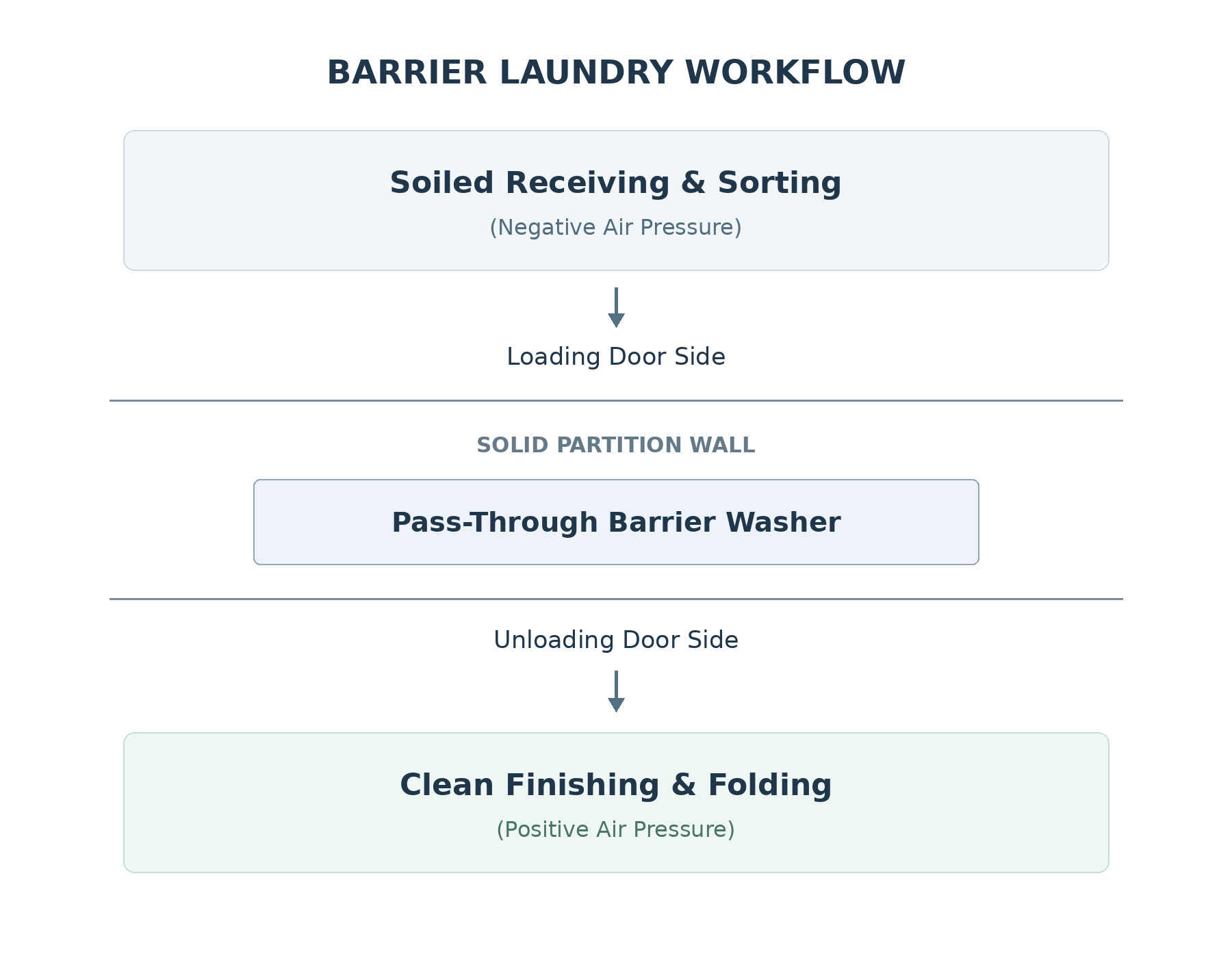
● Dedicated to receiving, sorting, weighing, and loading soiled inpatient bedding, patient gowns, and reusable isolation apparel.
● Maintained under negative air pressure (exhaust volume exceeds supply volume) to keep airborne lint and dust from drifting into adjacent hallways or the clean room.
Dedicated to unloading decontaminated linen, tumble drying, flatwork ironing, folding, inspection, and clean packing.
Maintained under positive air pressure with filtered air supply to prevent unfiltered ambient air from entering when service doors open.
A barrier washer requires specialized mechanical interlocking, chemical-resistant metallurgy, flexible thermal heating options, and dynamic vibration isolation to function reliably inside a structural wall cutout.
For healthcare institutions, cleanrooms, and commercial medical laundry plants, Flying Fish manufactures the GL Series Hygienic Barrier Automatic Washer-Extractors, available in six models from GL-20 (20 kg) to GL-120 (120 kg), all supporting both steam and electric heating.
The door interlock prevents cross-zone air exchange and operational errors:
● The clean-side unloading door unlocks only after the machine controller confirms full cycle completion, including the required thermal disinfection holding time.
● While the clean door is open during unloading, the soiled-side loading door remains locked mechanically and electrically.
● The soiled door can only be unlocked after the clean door has been closed and latched. Both doors cannot be open at the same time under any operating condition.
Hospital wash formulas expose internal and external surfaces to oxidizing chemicals (peracetic acid, sodium hypochlorite, and hydrogen peroxide) at high wash temperatures. The inner drum (ranging from Φ730×490 mm on GL-20 up to Φ1200×1070 mm on GL-120), outer tub, and exterior casing are fabricated from AISI 304 stainless steel to resist chemical pitting and surface degradation over long service cycles.
To accommodate various hospital utility infrastructures (central boiler steam vs. direct electric supply), every model in the GL Series is engineered to support both Steam Heating and Electric Heating configurations:
● Steam Heating Configuration: Utilizes high-efficiency heat exchangers operating at standard 0.4–0.6 MPa boiler steam pressure for rapid temperature rise.
● Electric Heating Configuration: Equipped with heavy-duty corrosion-resistant heating elements (ranging from 15 kW on GL-20 to 54 kW on GL-120) for facilities without boiler access.
Because the machine spans a wall opening, dynamic extraction loads from high-speed extraction at 750–920 RPM must not transfer into the partition structure:
● The internal drum assembly uses heavy-duty suspension springs and hydraulic dampers to isolate high-G extraction vibration from the base frame.
● A flexible, heat-resistant rubber expansion gasket seals the perimeter gap between the machine chassis and the wall opening, maintaining air pressure differentials without fatiguing from structural micro-movements.
Below are the verified factory engineering parameters for the Flying Fish GL Series pass-through barrier washer-extractors:
| Specification Parameter | GL-20 | GL-30 | GL-50 | GL-100 |
| Rated Capacity (Dry Load) | 20KG | 30KG | 50KG | 100KG |
| Inner Drum (D × L) | Φ730×490 | Φ900×500 | Φ970×720 | Φ1200×890 |
| Motor Power | 2.2 kW | 4.0 kW | 5.5 kW | 11.0 kW |
| Heating Configuration | Steam/Electric | Steam/Electric | Steam/Electric | Steam/Electric |
| Steam Pipe / Water Pipe | DN15 / DN25 | DN20 / DN40 | DN20 / DN40 | DN25 / DN50 |
| Drainage Diameter | DN50 | DN80 | DN80 | DN80 |
| Electric Heating Element | 15 kW | 24 kW | 30 kW | 45 kW |
| Machine Dimensions (W×D×H) | 1360×1250×1690 mm | 1370×1400×1800 mm | 1640×1500×1880 mm | 1810×1720×2150 mm |
| Net Machine Weight | ~800 KG | ~1140 KG | ~2000 KG | ~3000 KG |
| Standard Power Supply | 380V / 3Ph / 50Hz | 380V / 3Ph / 50Hz | 380V / 3Ph / 50Hz | 380V / 3Ph / 50Hz |
Engineering teams planning a hospital barrier laundry should review five site requirements during the schematic design phase:
1. Wall Aperture Dimensions: Form the wall opening according to the specific GL model's frame width and depth (e.g., leaving appropriate installation clearance for the perimeter rubber sealing frame).
2. HVAC Differential Pressure: Balance supply and exhaust fans to ensure negative pressure on the soiled side and positive pressure on the clean side. Maintain dedicated exhaust routing for each zone.
3. Finishing Equipment Exhaust: Dryers and flatwork ironer canopies in the clean room must vent moisture and heat independently outdoors; they must never tie into general room return air.
4. Drainage Separation: Soiled-side floor drains and machine discharge troughs (DN50 on GL-20, DN80 on GL-30–GL-120) must include backflow prevention and must not connect directly to clean-side floor trenches.
5. Cycle Capacity Sizing: Select machine capacities (20 kg to 120 kg) to match daily soiled linen volume while accounting for thermal holding times (e.g., 10–15 min at 85°C–90°C), which extend cycle durations compared to standard commercial wash formulas.
Proper barrier separation protects decontaminated textiles throughout the laundry cycle and supports RABC documentation and third-party certification under EN 14065.
Looking for dimensional drawings or equipment specifications? Contact the engineering team at Shanghai Flying Fish Machinery for GL Series technical datasheets, CAD wall cutout templates, and custom hospital laundry room layout planning.
Copyright © 2024 Shanghai Flying Fish Machinery Manufacturing Co.,Ltd . Privacy Policy
 EN
EN


 Hot News


