
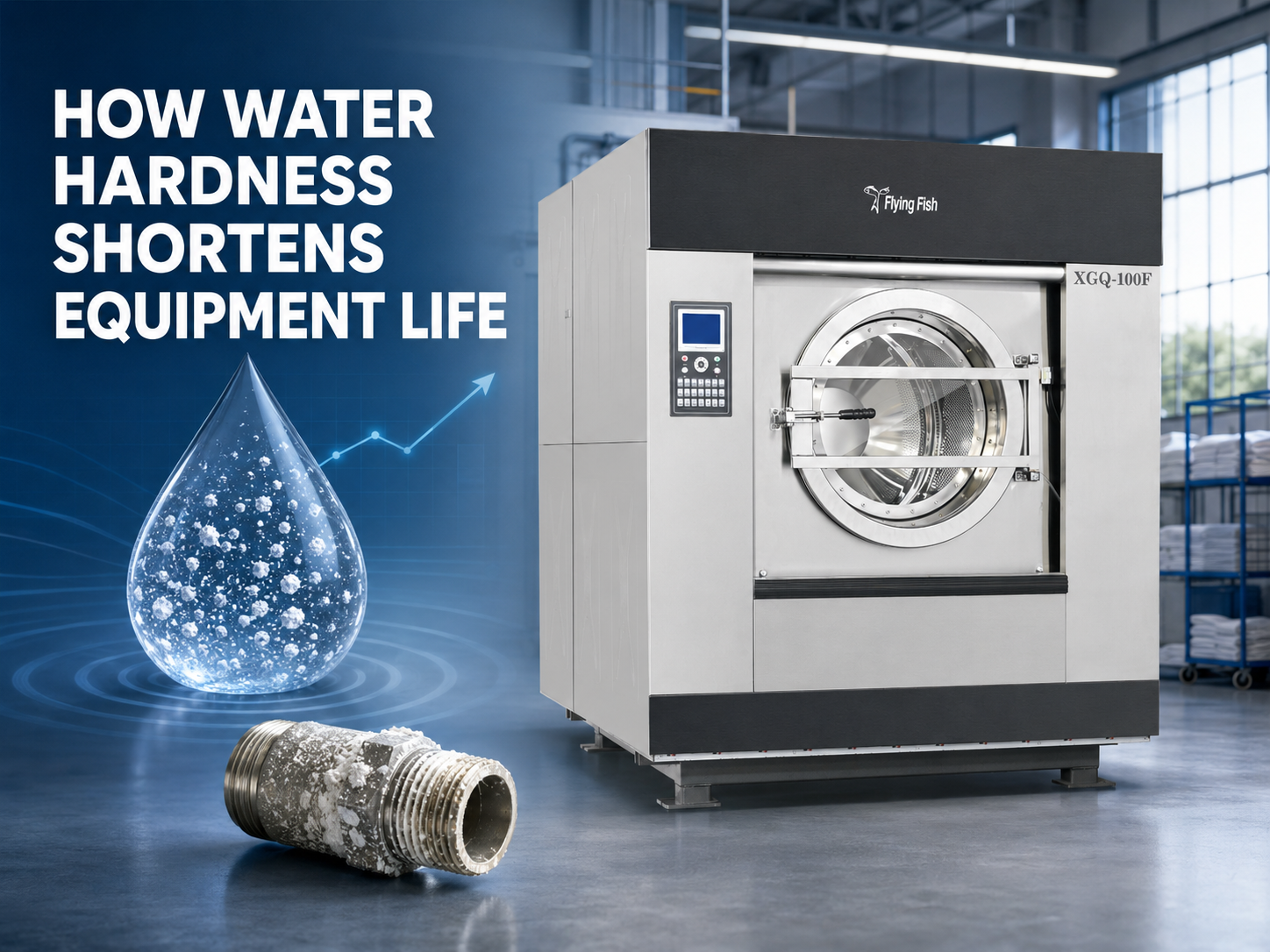
Ask any laundry manager why a washer extractor failed early, and the answer is usually a broken belt, a burned-out motor, or a valve that finally gave out. Rarely does anyone mention the water itself. Yet water hardness is one of the quiet reasons commercial laundry equipment ages faster than it should — minerals build up inside washers, dryers, and water heaters as scale, and over years that buildup eats into heating efficiency, wears down moving parts, and cuts equipment life well short of what the manufacturer intended.
This article looks at what water hardness actually is, how it wears down laundry equipment from the inside, and what operators can realistically do about it.
Water hardness refers to the amount of dissolved calcium and magnesium in a water supply, measured as calcium carbonate equivalent. The U.S. Geological Survey breaks it down into four bands:
|
Classification |
Hardness (mg/L as CaCO₃) |
|
Soft |
0–60 |
|
Moderately hard |
61–120 |
|
Hard |
121–180 |
|
Very hard |
More than 180 |
The harder the water coming into a facility, the more minerals get carried into every single cycle — and those minerals don't just wash away. They cling to heating elements, build up on valve seats, and coat pipe walls, cycle after cycle.
Heat is what turns dissolved minerals into a problem. When hard water is heated, calcium and magnesium drop out of solution and harden into limescale. In a commercial laundry running dozens or hundreds of cycles a week, this isn't a one-time event — it's constant, and it hits several parts of the machine at once.
Heating elements and boilers take the worst of it. Scale behaves like an insulating layer, so the heater has to run longer and push harder just to reach the same set temperature. Research summarized by the Pacific Northwest National Laboratory points to exactly this mechanism as a major driver of reduced heating efficiency in hard water conditions.
Valves and solenoids are next. Mineral deposits make them stick or leak, which throws off fill levels and leads to inconsistent wash results — sometimes the machine simply isn't getting the water volume it thinks it is. Pipework and spray systems narrow gradually as scale accumulates on the inside walls, quietly reducing flow and pressure over months. And inside the drum, mineral residue mixing with detergent tends to accelerate wear on seals and bearings, which shows up as extra vibration and noise long before anything actually fails.
And the numbers bear this out. A Water Quality Research Foundation study on softened water found that water heaters running untreated in very hard water lasted about 6.5 years on average — roughly half the 11 to 13 years typical in soft water conditions. The same research tracked tankless heater efficiency dropping from around 80% down to 72% before descaling was performed. Separately, industry sources note that a scale layer as thin as 6 millimeters (about a quarter inch) can cut heat-transfer efficiency by up to 40%.
For a laundry running washer extractors and dryers on electric, steam, or gas heat, that efficiency loss shows up first as a higher utility bill, then later as equipment that needs replacing years ahead of schedule — even when everything else about the machine was built to last.
Nobody needs a water lab to catch the early warning signs. In practice, they tend to show up as:
● Hot-wash cycles taking noticeably longer to reach temperature
● White or gray residue building up inside drums, on seals, or around detergent trays
● Weaker water pressure at spray or rinse points
● Valves and solenoids needing replacement more often than they used to
● Energy bills creeping up with no real change in laundry volume
● Linens coming out looking dull or slightly gray despite correct detergent dosing
None of these alone is proof of a hard water problem. But when two or three show up together, water hardness is usually part of the story — not just a machine getting old.
Start by testing the water. Any new laundry installation should include a basic hardness test, in mg/L or grains per gallon, and it's worth repeating if the water source ever changes.
Treat the water where hardness is high. Ion-exchange softeners remain the standard commercial fix, swapping calcium and magnesium for sodium before water reaches the machines. In very hard water areas, this usually costs less over time than replacing heaters and valves on a rolling basis.
Build descaling into the maintenance schedule, not just the repair list. Heating elements, boiler tanks, and pipework should be descaled on a set interval tied to local water hardness — waiting for a fault to show up means the damage is already done.
Choose equipment designed to handle mineral stress. Multi-layer seals, stainless-steel drums and panels, and bearings that can be serviced from outside the machine — the kind of build found in Flying Fish industrial washer extractors — won't stop scale from forming, but they reduce how much it costs when it does, and make descaling far less disruptive.
Watch energy use as an early warning system. A slow, steady rise in energy per load is often the first measurable sign of scale buildup, and it usually shows up long before anything visibly breaks.
Most operators can't change the water coming into their building, but they can control what happens to it once it arrives. Testing hardness, treating it where it matters, keeping descaling on a schedule, and choosing equipment built for the long haul — together these can add years to a machine's working life and keep energy costs from creeping up unnoticed.
Flying Fish builds industrial washer extractors, tumble dryers, and barrier washers with corrosion-resistant stainless steel and accessible service points, for hotels, hospitals, laundromats, and industrial laundries operating across a wide range of water conditions.
Explore Flying Fish washer extractors or request equipment guidance.
What water hardness level requires treatment for commercial laundry equipment?
Once water crosses roughly 120 mg/L — moderately hard to hard on the USGS scale — it's usually worth investing in water treatment or scheduling descaling more frequently for equipment that heats water often.
How often should commercial laundry equipment be descaled?
It depends on local water hardness and how hard the equipment works. High-hardness areas with heavy daily use may need descaling every few months; soft-water regions might only need it once a year. A water test is the fastest way to figure out where you land.
Does a water softener really extend equipment life?
The research says yes. Independent studies on softened water consistently show longer heater lifespans and better-maintained efficiency compared to untreated hard water, particularly for heating elements and boiler tanks.
Can scale increase energy bills before a machine actually breaks down?
Yes, and usually well before. Scale insulates heating surfaces, so the machine burns more energy reaching the same temperature long before any fault becomes visible.
Are stainless-steel machines immune to hard water damage?
Not immune — just more resistant to corrosion than untreated metal. Stainless steel doesn't stop mineral scale from forming, so water treatment and regular descaling still matter regardless of what the drum is made of.
PNNL: Impacts of Water Quality on Residential Water Heating Equipment
Water Quality Research Foundation: Softened Water Benefits Study
Flying Fish: Industrial Washer Extractor
Copyright © 2024 Shanghai Flying Fish Machinery Manufacturing Co.,Ltd . Privacy Policy
 EN
EN


 Hot News


