
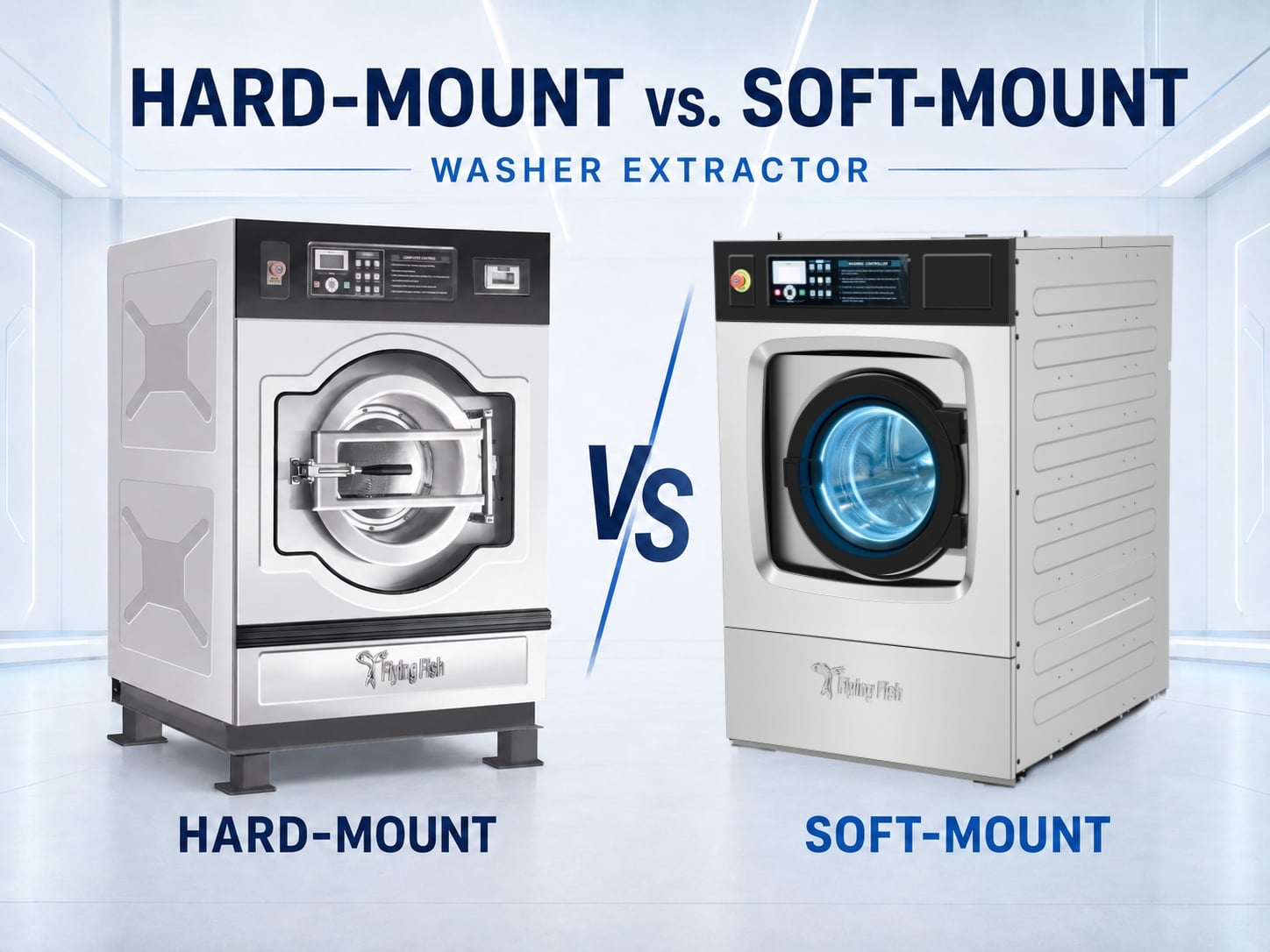
At first glance, hard-mount and soft-mount washer extractors do the same job. Both wash textiles and remove water through high-speed spinning before the load moves to a dryer or finishing line.
The important difference is hidden inside—and underneath—the machine.
A hard-mount washer relies heavily on the building structure to control movement during extraction. A soft-mount washer uses an internal suspension system to absorb much of that movement before it reaches the floor.
This distinction affects far more than installation. It can influence where the washer can be placed, how the laundry room is prepared and how the complete wash-and-dry process performs.
A hard-mount washer extractor, also called a rigid-mount or fixed-mount washer, has a wash assembly that is rigidly connected to its frame.
During extraction, the rotating load creates dynamic forces. Because the machine does not isolate these forces through a full suspension system, it must transfer them into a suitable foundation.
For this reason, hard-mount machines are normally anchored to a level, structurally adequate concrete floor or foundation according to the manufacturer’s installation instructions. Grouting or a purpose-built concrete pad may also be required for certain models.
This does not mean that every hard-mount washer needs the same foundation. Machine weight, capacity, extraction speed, floor construction and local building conditions all matter. The correct foundation and anchoring method must come from the technical manual for the specific model.
A soft-mount washer extractor is also known as a suspended or flexibly mounted washer.
Its wash assembly is supported by a suspension system, typically incorporating springs and dampers. This system allows the inner assembly to move within controlled limits and reduces the amount of vibration transmitted to the machine frame and floor.
Because the suspension manages much of the dynamic movement, soft-mount machines generally have less demanding foundation requirements than comparable rigid-mount models. Many are designed for installation without a special reinforced foundation.
However, “no special foundation” does not mean “suitable for any floor.”
The floor must still be level and capable of supporting the machine’s static and dynamic loads. Upper-floor installations should be checked against the equipment manufacturer’s requirements, and a structural engineer may be needed when the building capacity is uncertain.
| Factor | Hard-mount washer extractor | Soft-mount washer extractor |
|---|---|---|
| Alternative names | Rigid-mount, fixed-mount | Suspended, flexibly mounted |
| Wash assembly | Rigidly connected to the frame | Supported by a suspension system |
| Vibration control | Relies largely on the machine foundation | Suspension absorbs much of the movement |
| Installation | Normally anchored to suitable concrete | Often does not require a special foundation |
| Floor preparation | Usually more demanding | Usually simpler, subject to model requirements |
| Location flexibility | More dependent on floor construction | Often more flexible |
| Extraction speed | Depends on the individual model | Depends on the individual model |
| Maintenance focus | Anchors, grout and foundation condition | Springs, dampers and transport restraints |
| Purchase decision | Must include foundation work | Must include suspension condition and floor loading |
This comparison describes the general mechanical principles. The final decision should always be based on the specifications and installation manual of the actual machine.
Soft-mount machines are often designed for higher extraction speeds because their suspension systems isolate more of the movement created during spinning. But this should not be treated as a universal rule.
G-force depends on two factors: drum radius and rotational speed. Two machines with the same RPM can therefore produce different extraction forces if their drum diameters are different.
When comparing washer extractors, do not rely on labels such as “high speed” or look at RPM alone. Compare the published G-force for the specific models.
Higher extraction force can reduce the amount of water left in the load, but the final moisture level also depends on:
● Textile type
● Load size and balance
● Wash program
● Extraction time
● Drum design
● Fabric absorbency
A higher G-force can reduce the work required from the dryer, but it does not guarantee the same drying-time reduction for every type of textile.
Many buyers begin by comparing machine prices. In practice, the building may narrow the choice before the price does.
Before selecting a hard-mount washer, check:
● Concrete quality and thickness
● Foundation and anchoring requirements
● Available drainage
● Space for loading and maintenance
● Dynamic floor loads
● Whether foundation work will interrupt current operations
A hard-mount washer may be a practical choice when the facility already has a suitable slab-on-grade concrete floor and can complete the required anchoring work.
A soft-mount washer may be more practical when extensive foundation construction is difficult, the laundry room is being renovated or the installation location requires better vibration isolation.
Neither design removes the need for proper planning. Incorrect leveling, poor floor conditions or failure to follow anchoring instructions can cause vibration and premature wear in either type of machine.
Soft-mount machines are designed to isolate vibration, but a suspension system cannot correct every operating problem.
Excessive movement may still occur when:
● The load is badly unbalanced
● The machine is not level
● Shipping restraints have not been removed
● Springs or dampers are worn
● The floor is unstable
● The washer is overloaded
● Foreign objects are trapped in the drum
Hard-mount machines also depend on correct loading, but their foundation and anchors play a particularly important role. Loose anchors, damaged grout or an unsuitable floor can allow vibration to increase over time.
Noise should therefore be evaluated as part of the full installation—not as a feature determined only by the words “hard-mount” or “soft-mount.”
Both designs require preventive maintenance.
For a hard-mount washer, inspections may include the anchoring system, grout, frame and surrounding concrete. Any movement between the machine and foundation should be investigated rather than simply tightening bolts repeatedly without finding the cause.
For a soft-mount washer, the suspension components require attention. Springs, dampers and related mounting points should be inspected according to the manufacturer’s maintenance schedule.
Transport restraints are another important consideration. Suspended assemblies are normally secured during shipping. These restraints must be removed before operation and may need to be reinstalled before the machine is moved again. The exact procedure varies by model.
A hard-mount washer extractor may be appropriate when:
● A suitable concrete foundation is already available
● The installation is at ground level
● Foundation and anchoring work can be completed correctly
● The selected model meets the required production capacity
● The facility wants a mechanically straightforward configuration
A soft-mount washer extractor may be appropriate when:
● Special foundation construction needs to be minimized
● Installation flexibility is important
● Less vibration transfer to the surrounding structure is required
● Higher extraction performance is available in the selected model
● The existing floor meets the machine’s stated load requirements
The answer should not be based on machine type alone. Capacity, cycle programming, water and power supply, drainage, chemical dosing, service access and downstream dryer capacity remain equally important.
One common source of confusion is the way equipment categories are named.
“Industrial washer extractor” describes the machine’s intended workload or market position. It does not automatically describe how the wash assembly is mounted.
An industrial-capacity washer may be suspended. A smaller commercial washer may be rigid-mounted. Product category, load capacity and mounting structure are separate characteristics.
Before requesting a quotation, ask the supplier to confirm:
● Is the machine rigid-mounted or suspended?
● Does it require anchoring?
● What foundation or floor conditions are required?
● What is its rated G-force?
● What are the static and dynamic floor loads?
● What maintenance space must be reserved?
Clear answers to these questions are more useful than a general description such as “heavy-duty” or “high-speed.”
The best washer is not necessarily the one with the highest extraction speed or the simplest installation. It is the one that fits the building, the textile mix and the complete laundry workflow.
A rigid-mount washer can be a sound choice on a correctly prepared concrete foundation. A suspended washer can offer greater installation flexibility and reduced vibration transfer. Both can perform reliably when selected, installed and maintained correctly.
Flying Fish offers full-suspension washer extractors for commercial and industrial laundry applications. Before recommending a configuration, we consider daily load volume, textile type, available utilities, floor conditions and the capacity of the downstream drying or finishing equipment.
If you are planning a new laundry or replacing existing washers, send us your required capacity and installation conditions. This information will help determine whether the proposed equipment is suitable for your facility—not only on paper, but in daily operation.
Copyright © 2024 Shanghai Flying Fish Machinery Manufacturing Co.,Ltd . Privacy Policy
 EN
EN


 Hot News


